End-of-Season Gear Care: Guns, Boots, Vests, and Dog Gear
Every season ends the same way. Not with the last rooster, but with the last walk back to the truck, the dogs loaded, the vest thrown on the floorboard with two shells and a tail feather still in the game bag. Then the gear sits in the garage until somebody needs it in October, and October-you finds out what November-you didn’t do.
This is the put-away guide. It works two ways. If your season is still rolling (and in most of our seven states it is, deep into December or January), use it as the between-trips reset after a wet weekend. When your last state closes, run the whole list once, carefully, and next fall starts with a gun that cycles, boots that don’t leak, and a GPS collar that actually holds a charge.
For when each state closes, see December Pheasant Hunting by State. If a preserve hunt is how you stretch the year, our featured guide, Wild Birds vs. Preserve Hunts, covers preserve and controlled-shooting-area seasons that run well past the wild-bird closers. Before any late trip, check whether your license expires before the season does.
The order of operations
Do it in this order and nothing gets skipped:
- Guns first, because they rust fastest and matter most.
- Ammunition next, while the gun is apart and you’re thinking about it.
- Boots, before the mud dries into the seams.
- Vests, coats, and brush pants, pockets and all.
- Dogs and dog gear, because the dog is the one who can’t tell you something’s wrong.
- Paperwork: the harvest survey and your notes.
1. The shotgun
Make it safe before you touch a brush
Before any cleaning, treat the gun the way Nebraska Game and Parks tells every hunter to: treat every firearm as if it is loaded, control the muzzle, and keep your finger out of the trigger guard. NGPC also says to keep firearms unloaded when not in use, including while riding in a vehicle or ATV. Open the action, look in the chamber, check the magazine tube, and move every shell out of the room before you start. Sources: NGPC hunt safe tips · Hunter education: general cleaning instructions.
Field advice: The end of the season is when the “I know it’s empty” mistakes happen. The gun has been loaded and unloaded a hundred times in the field; at the bench it’s tempting to skip the check. Don’t. Look, and feel, every time.
The clean
The National Hunter Safety Course study guide at hunter-ed.com lays out the basics:
- Follow the instructions that came with your cleaning kit.
- Use a cloth and solvent to remove dirt, powder residue, skin oils, and moisture from the action and other metal parts.
- Clean the barrel from the breech end when you can, with a bore guide and a rod carrying a solvent-wetted brush or patch, all the way through. Repeat with fresh patches.
- Brush out the crevices where powder residue builds up.
- Finish the barrel with a dry patch, then a lightly oiled patch, and give the metal a coat of gun oil to protect it from rust.
- Use a flexible pull-through cable on semi-autos and other actions where pushing a rod could drive grime into the action.
- Use solvents in a well-ventilated area and only as directed.
Source: Hunter education: general cleaning instructions.
Field advice for pheasant guns specifically:
- Chokes. If your gun takes screw-in chokes, pull them, clean the threads and the tube, and put a light film of choke grease or oil on the threads before reinstalling. A choke left in all winter after a sleet day can be hard to get out in spring. More on choke choice in Shotgun Choke Guide for Upland.
- Wet days. Snow melting in the cab and cattail water in the action are how a clean gun rusts in a week. After any wet hunt, mid-season or not, wipe it down that night. The full clean can wait for the weekend; the wipe-down can’t.
- The stock. Water and blood wick under recoil pads and into checkering. Pull the pad if it’s easy and you’re comfortable doing it; otherwise wipe and let it dry out of the case.
- Cased storage. A gun put in a soft case wet stays wet. Let the gun and the case dry separately before they go back together.
- Anything that felt wrong. A failure to feed, a sticky safety, a loose rib. The off-season is when a gunsmith has time. Write it down now, while you remember which gun did it.
Lead hygiene at the bench
If you shot lead loads this season, cleaning the gun means handling lead residue. NIOSH, writing about firing ranges, says shooters should wash hands, forearms, and face before eating, drinking, or smoking after shooting, handling spent shells, or cleaning weapons. It also notes that plain soap and water does not completely remove lead from skin, and that lead decontamination wipes are commercially available. NIOSH recommends gloves and eye protection when using chemicals to clean firearms. Sources: NIOSH Alert 2009-136 · NIOSH Science Bulletin: firing ranges.
Field advice: Clean guns in the garage or shop, not on the kitchen table. Keep kids and snacks out of the area. If your public-land habit means you shoot mostly non-toxic loads anyway, the problem gets smaller. See Non-Toxic Shot on Public Land.
Storage
SAAMI (the ammunition and firearm industry’s standards body) says firearms should be secured to prevent access by unauthorized people such as children, and ammunition should be stored separately from firearms and kept away from unauthorized people. Source: SAAMI, Recommendations for Safe Ammunition Storage and Handling.
2. The shells
By January, most of us have a coffee can of mixed loads: three brands, two shot sizes, some steel, some lead, and a few that rode in a wet vest for six weeks. Sort them now.
SAAMI’s storage guidance:
- Store ammunition in its original packaging or packaging designed for it.
- Keep it in a cool, dry place, away from solvents and other chemicals, heat sources, and open flames.
- Don’t leave ammunition in a vehicle, including the trunk, for extended periods in direct sun or high heat; SAAMI says that can speed deterioration of the propellant.
- Inspect before use. Dispose of shells that show physical damage, such as corrosion or deep dents, and if in doubt, don’t chamber it. Dispose of ammunition only in line with federal, state, and local rules; SAAMI says local law enforcement, the fire department, or a shooting facility may be able to advise.
- SAAMI notes that long exposure to moisture and chemicals can cause failure to fire, incomplete burning, or delayed firing.
Source: SAAMI, Recommendations for Safe Ammunition Storage and Handling.
Field advice:
- Empty every pocket. Vest, coat, brush pants, truck console, the door pocket. Shells that spent the season in a soaked vest go in their own box, marked, for inspection.
- Separate non-toxic from lead and label the boxes. Next October you’ll want to grab the right loads for a WPA, refuge, or a Nebraska release WMA without reading headstamps in the dark. The why is in Non-Toxic Shot on Public Land; shot-size thinking is in Best Shot Size for Pheasants.
- Inventory now. Count what’s left by load. It’s the cheapest way to know what to restock before next season, rather than finding out on the Friday before opener.
3. Boots
Boots take the worst of a pheasant season: wet CRP at dawn, frozen plowed ground at noon, cattail water by afternoon. Danner’s care guidance is a good baseline for any leather upland boot:
- Brush off dirt and debris as often as you like, and deep-clean when they look dirty.
- Condition leather as it begins to look dry or worn; Danner suggests roughly every couple of months for regular wear and as often as weekly for heavy use. Use the right product for the leather: full-grain conditioners aren’t for suede or nubuck.
- If boots are wet inside, dry them with a boot dryer after each wear to keep odor-causing bacteria down.
- Keep footwear away from extreme heat sources, such as fires and cars left in direct sunlight. Drying too fast can damage leather and rubber.
Source: Danner, Footwear Care. Follow your own boot maker’s instructions where they differ, especially for waterproof membranes.
Field advice:
- Pull the insoles and let them dry separately. Most boot funk lives there.
- Check the seams and the rand (where the upper meets the sole). That’s where the walk-in grass and cockleburs eat a boot. Small separations are a cobbler or warranty job now, a soaked foot next November.
- Store them clean, dry, and conditioned, out of a hot garage and off a cold concrete floor.
- If they’re done, they’re done. Shopping notes are in our Upland Boots Buying Guide.
4. Vests, coats, and brush pants
De-seed everything before it goes in the tote
Pheasant cover is weed seed country, and your gear is the delivery system. Minnesota DNR’s guidance for hunters on public land:
- Before leaving home, check all your gear and your dog for mud, seeds, and vegetation, and remove and dispose of what you find.
- During the hunt, check yourself for sticking seeds, especially off trail.
- After, check yourself, gear, pets, and vehicles for seeds, mud, and vegetation. Double-check socks and pockets. If you clean up at home, dispose of the seeds properly.
Source: Minnesota DNR, Protect your public lands when hunting. For tough burrs on pets, the PlayCleanGo invasive-species campaign, which Minnesota DNR points hunters to, suggests a little coconut oil and pinching the burr so it breaks up and can be combed out. Source: PlayCleanGo, Take Action.
Field advice: Work over a tarp or a trash bag, not the lawn. Turn the game bag inside out. Shake the brush pants, then go after the cuffs and the Velcro with a stiff brush. Seed heads hide in the folds of a blaze cap, too.
The game bag
Field advice: The game bag is where blood, feathers, and the occasional forgotten wing sit for weeks. Empty it completely, then wash the vest according to its care label. If the label says hand-wash only, believe it; some waxed and coated fabrics don’t survive a machine. Let everything dry fully before storage, and store blaze gear out of direct sun.
While you’re there, check the blaze itself. Some states require blaze during deer-season overlap, and the rules differ. If your cap or vest is faded, torn, or doesn’t cover what your state’s rule requires, replace it before next fall. Rules by state: Blaze Orange Requirements by State.
5. Dogs and dog gear
The dog
The dog took more beating than any piece of gear you own. Give it a real once-over.
UC Davis School of Veterinary Medicine on grass awns (foxtails), the spiked seed heads that are common in upland cover:
- They most often enter through the nose, mouth, ears, and eyes, and can also penetrate skin. Because of their shape, an embedded awn can’t back out on its own and can migrate deeper, causing abscesses and infection.
- Signs include persistent sneezing, snorting, nasal discharge, head shaking or tilting, pawing at the head, limping, swelling, or excessive licking of one spot.
- If an awn is easily accessible, you can remove it with tweezers, making sure you get the whole seed head. If any part may remain, or it’s embedded with redness or swelling, see your veterinarian. Earlier removal is easier.
- Groom carefully after time in that cover: between the toes, the ears, armpits, and groin. Keeping hair between the toes, around the ears, and on the belly trimmed helps.
Source: UC Davis School of Veterinary Medicine, Foxtails and Dogs. Cold-season pads, ice balls, and hypothermia signs are covered in Cold-Weather Care for Pheasant Dogs.
Field advice: Book a post-season vet visit if the dog limped, coughed, shook its head, or lost condition this year. Tell the vet what kind of cover the dog worked. A dog that ran cattails and CRP for three months is a different patient than a couch dog.
GPS and e-collars
Lithium batteries don’t like being stored full and hot. Garmin’s long-term storage instructions for its Alpha dog-tracking system say:
- If you won’t use the collar for several months, charge its battery to about 50%.
- Store it in a cool, dry place at around typical household temperature.
- For the handheld, remove the battery if you won’t use it for several months (stored data isn’t lost).
- Fully recharge the collar before using it again.
- Garmin notes that heat speeds the normal loss of lithium-ion battery capacity, and storing a fully charged device outside the recommended temperature range can significantly reduce its recharging capacity.
Source: Garmin Alpha 50 manual, Long-Term Storage. Garmin’s separate lithium-ion battery instructions add: don’t store batteries in your vehicle or in high-temperature areas, and charge every six months during long-term storage. Other brands differ; follow your own device’s manual.
Field advice: The truck console is exactly where a collar and handheld end up for the winter. Bring them inside. Set a phone reminder to top them up mid-off-season. Check straps, contact points, and antennas for wear while you’re at it; more on collars and whistles in E-Collars and Whistles for Upland.
Vests, booties, leads, and kennels
Field advice:
- Dog vests and booties: wash or rinse per the maker’s directions, dry fully, and check for worn straps and torn panels. Burrs live in the Velcro.
- Leads, check cords, and collars: look for frayed stitching and worn buckles. A collar that’s cracked in January will fail in October.
- Kennels and crates: pull the pads, vacuum out the seeds and hair, wash, and dry. Check doors, latches, and tie-downs. Clean the truck bed or cargo area under them; that’s where a season’s worth of weed seed collects.
- First-aid kit: restock what you used, and check expiration dates on anything that has them. Kit list: First Aid and Truck Kit for Upland Days and Pheasant Dog Gear Checklist.
6. Paperwork: answer the survey, write the notes
This is the part almost nobody does, and it’s the part that shapes next season.
Harvest surveys. State agencies use post-season surveys to estimate harvest and set future seasons, and they mean it when they say they want the bad days too:
- South Dakota GFP emails harvest surveys at the end of each hunting season to licensed hunters with a working email address, followed by two reminder emails. GFP says an unsuccessful hunt is as important to report as a successful one, and that it’s important to report whether you hunted at all. Source: SD GFP, Harvest Reports and Surveys.
- Minnesota DNR mails a postcard survey to a random sample of small game license buyers after the season closes. For the 2025–26 season it went out in early March 2026 to 7,000 license holders (about 3%), asking whether they hunted, days hunted, birds bagged by species, and the county hunted most. Source: MN DNR, 2025 Small Game Hunter Mail Survey.
- North Dakota Game and Fish sends surveys to a random selection of hunters. The department has said that if a successful hunter doesn’t return a survey it must assume they were unsuccessful, which leads to an underestimate of the harvest, and that surveys from hunters who got nothing, or never made it out, are just as important. Source: NDGF, Evaluating Days in the Field.
Other states run their own surveys on their own schedules. If one lands in your inbox or mailbox, answer it honestly. It takes a few minutes.
Your own notes. Field advice: Write down, while you still remember it, which walk-ins held birds and when, where you parked, which cover pushed well with your crew size, what the dog struggled with, and what gear failed. Our Mid-Season Scout Notes format works just as well as an end-of-season debrief, and your offline maps are the place to pin it.
The put-away checklist
Guns
- [ ] Action open, chamber and magazine checked, ammunition out of the room
- [ ] Cleaned per your kit and the hunter-ed basics; light oil on the metal
- [ ] Chokes out, threads cleaned and lubed, reinstalled
- [ ] Gun and soft case dried separately
- [ ] Anything that malfunctioned written down for the gunsmith
- [ ] Stored secured from unauthorized access; ammunition stored separately
- [ ] Hands, forearms, and face washed after cleaning
Ammunition
- [ ] Every pocket, vest, and console emptied
- [ ] Wet or damaged shells set aside for inspection or proper disposal
- [ ] Non-toxic and lead separated and labeled
- [ ] Stored in original boxes, cool and dry, away from solvents and heat, out of the truck
- [ ] Inventory written down for restocking
Boots and clothing
- [ ] Boots brushed, cleaned, dried away from direct heat, conditioned
- [ ] Insoles out; seams and rands checked
- [ ] Vest, coat, pants de-seeded over a tarp; seeds bagged and disposed of
- [ ] Game bag emptied; gear washed per care labels and fully dried
- [ ] Blaze gear checked against your state’s rules
Dogs
- [ ] Ears, nose, eyes, between toes, armpits, groin checked for awns
- [ ] Vet visit booked if anything looked off
- [ ] GPS collar at about 50% charge, stored indoors; handheld battery removed if your manual says so
- [ ] Vests, booties, leads, kennel pads cleaned, dried, and inspected
- [ ] First-aid kit restocked
Paperwork
- [ ] Answer any harvest survey you receive, even if you didn’t get a bird
- [ ] Season notes written and pinned to your maps
Featured gear: partner slots
Empty until a real affiliate exists. We don’t rank brands on this page.
Name TBD · Why it matters: hunter education recommends cleaning from the breech with a bore guide and finishing with a light coat of oil against rust · Who it's for: anyone putting a pheasant gun away for the winter · Partner link coming
Name TBD · Why it matters: Danner recommends a boot dryer after each wear when boots are wet inside, and warns against drying near fires or other extreme heat · Who it's for: late-season hunters coming home with wet boots · Partner link coming
Related
- Thanksgiving-Week Pheasant Hunting (featured)
- Wild Birds vs. Preserve Hunts
- December Pheasant Hunting by State
- Cold-Weather Care for Pheasant Dogs
- Pheasant Hunting Gear Checklist
- Pheasant Dog Gear Checklist
- Upland Boots Buying Guide
- Shotgun Choke Guide for Upland
- Non-Toxic Shot on Public Land
- E-Collars and Whistles for Upland
- First Aid and Truck Kit for Upland Days
- Mid-Season Scout Notes
Sources
- Nebraska Game and Parks — Hunt safe tips (treat every firearm as if it is loaded; control the muzzle; finger out of the trigger guard; keep firearms unloaded when not in use, including while riding in a vehicle or ATV)
- National Hunter Safety Course (hunter-ed.com) — General cleaning instructions (follow kit instructions; cloth and solvent for dirt, residue, skin oils, moisture; clean from breech with bore guide; dry patch then lightly oiled patch; gun oil against rust; pull-through cable for lever and semi-auto actions; solvents in well-ventilated area)
- NIOSH Alert 2009-136 — Preventing occupational exposures to lead and noise at indoor firing ranges (wash hands, forearms, face before eating, drinking, smoking; soap and water not completely effective at removing lead; decontamination wipes after shooting, handling spent cases, or cleaning weapons)
- NIOSH Science Bulletin — Take aim at protecting yourself (gloves and eye protection when using chemicals to clean weapons; hygiene steps)
- SAAMI — Recommendations for Safe Ammunition Storage and Handling (original packaging; cool, dry location away from solvents, heat, flame; not in vehicles for extended periods in sun or heat; store separately from firearms and inaccessible to unauthorized persons; secure firearms; inspect and dispose of damaged ammunition per federal, state, local rules; moisture and chemical effects)
- Danner — Footwear Care (brush and deep clean; condition about every couple of months for regular wear, up to weekly for heavy use; boot dryer after each wear when wet inside; keep away from fires and hot cars)
- Minnesota DNR — Protect your public lands when hunting (check gear and dog before; check during; check self, gear, pets, vehicles after, including socks and pockets; dispose of seeds properly)
- PlayCleanGo — Take Action (hunting steps; coconut oil and pinch method for tough burrs on pets)
- UC Davis School of Veterinary Medicine — Foxtails and Dogs (entry points; migration; clinical signs; removal of whole seed head; see a vet if embedded or remnants remain; grooming and trimming between toes, ears, belly)
- Garmin — Alpha 50 Long-Term Storage (collar ~50% charge for storage of several months; cool, dry, household temperatures; remove handheld battery; fully recharge before use; heat accelerates capacity loss)
- Garmin — Lithium-ion battery instructions (do not store in vehicle or high-temperature areas; charge every six months during long-term storage)
- South Dakota GFP — Harvest Reports and Surveys (surveys emailed at end of each season to hunters with working email; two follow-up reminders; unsuccessful hunts and not hunting are important to report; results inform next season)
- Minnesota DNR — 2025 Small Game Hunter Mail Survey (postcard mailed early March 2026 to stratified random sample of 7,000, ~3%; questions on hunting, days, bag by species, county; used to guide regulations and season structure)
- North Dakota Game and Fish — Evaluating Days in the Field (random selection of hunters; non-returned surveys from successful hunters lead to harvest underestimates; unsuccessful hunters' surveys equally important)
- On this site: Thanksgiving-Week Pheasant Hunting · Wild Birds vs. Preserve Hunts · December Pheasant Hunting by State · Cold-Weather Care for Pheasant Dogs · Non-Toxic Shot on Public Land · Blaze Orange Requirements by State
- All sources above checked live 2026-11-19. This guide states no season dates, bag limits, license fees, or product prices.
- Danner and Garmin are cited as examples of manufacturer care guidance, not endorsements; their instructions apply to their own products. Follow your own manuals.
- The North Dakota survey article is from 2017 (NDGF magazine); delivery methods may have changed since, but NDGF's stated reasons for answering are what we cite.
- Chokes, stock care, pocket-emptying, labeling, notes, vet-visit, and kennel advice are labeled field advice.
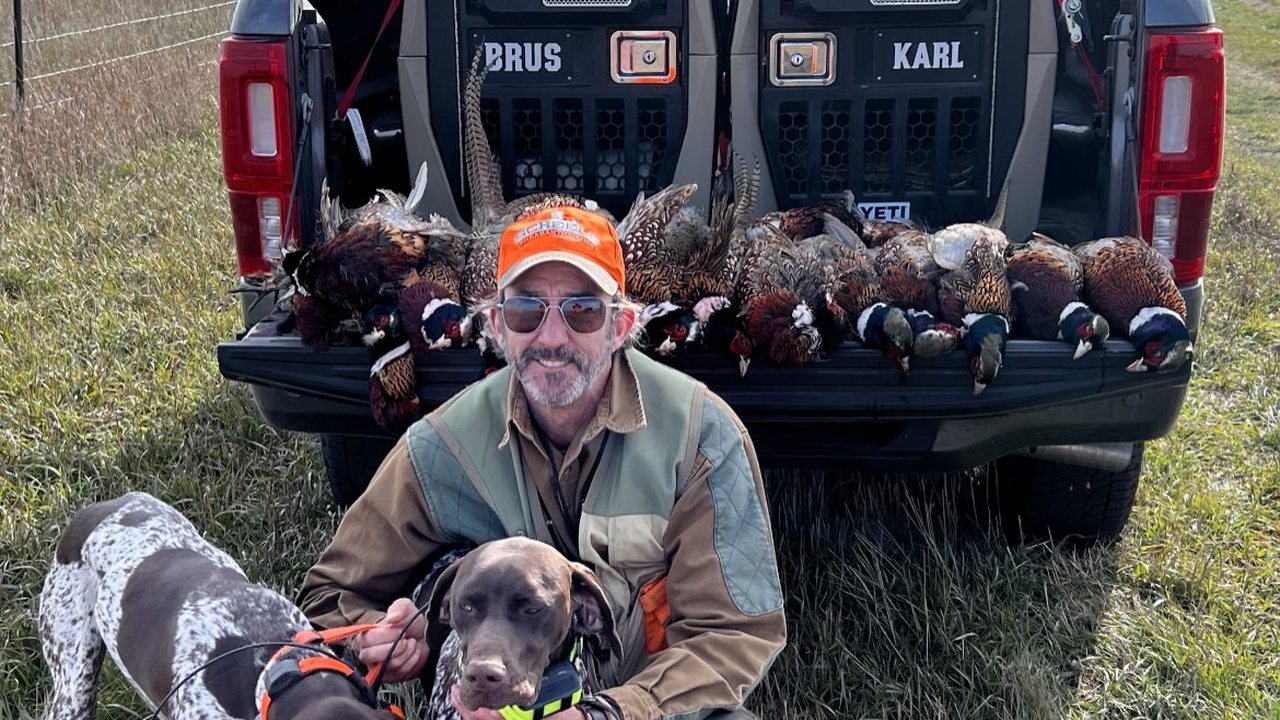
- Photo: Crouse family frame of Brüs (orange collar) and Karl (green collar) in Nebraska, cropped to 16:9; hunter not named.