Reading Pheasant Sign: Tracks, Roosts, and Feeding Edges
Every rooster leaves a paper trail. Before a single bird flushes, the ground has already told you where he slept, where he ate, where he picked up gravel, and which ditch he crossed on the way to the thick stuff. Most hunters walk right over it. The ones who slow down for thirty seconds at the tailgate tend to put the dog in the right cover first.
This guide is about that thirty seconds. Minnesota DNR tells hunters to scout for sign “such as tracks, roosts, droppings and the birds themselves.” Below we take each of those in turn, explain what the state agencies and university extension say about how pheasants actually use the land, and then turn it into a plan. It pairs with Late-October Cover Shifts for the post-harvest map, Hunting Pheasants After the First Snow for the one week a year the sign reads itself, and Mid-Season Scout Notes for the walk-in side of scouting.
Start with the bird’s day
Sign only makes sense if you know the schedule that made it. Minnesota DNR lays out a typical fall day:
- Before sunrise: birds are on the roost, usually in short-to-medium grass or weeds.
- First light: they walk to roadsides for gravel and grit, then typically start feeding around 8 a.m., often in grain fields.
- Mid-morning to late afternoon: they move into the densest cover around, such as standing corn, CRP, brush, wetlands, and native grass, and loaf there. In DNR’s words, “the nastier the weather, the deeper into cover.”
- Late afternoon: back out to feed, then to the roost.
Montana State University Extension describes the same two feeding periods a day, with loafing cover in between where birds sun, shade up, and “wallow in the dust.” The USDA NRCS pheasant technical note places roost sites near feeding areas.
What that means for sign: every track, dropping, and dust bowl you find belongs to one stop on that loop. Your job is to work out which stop, and which way the bird was headed.
Tracks
Pheasant tracks are the easiest sign to find and the easiest to over-read.
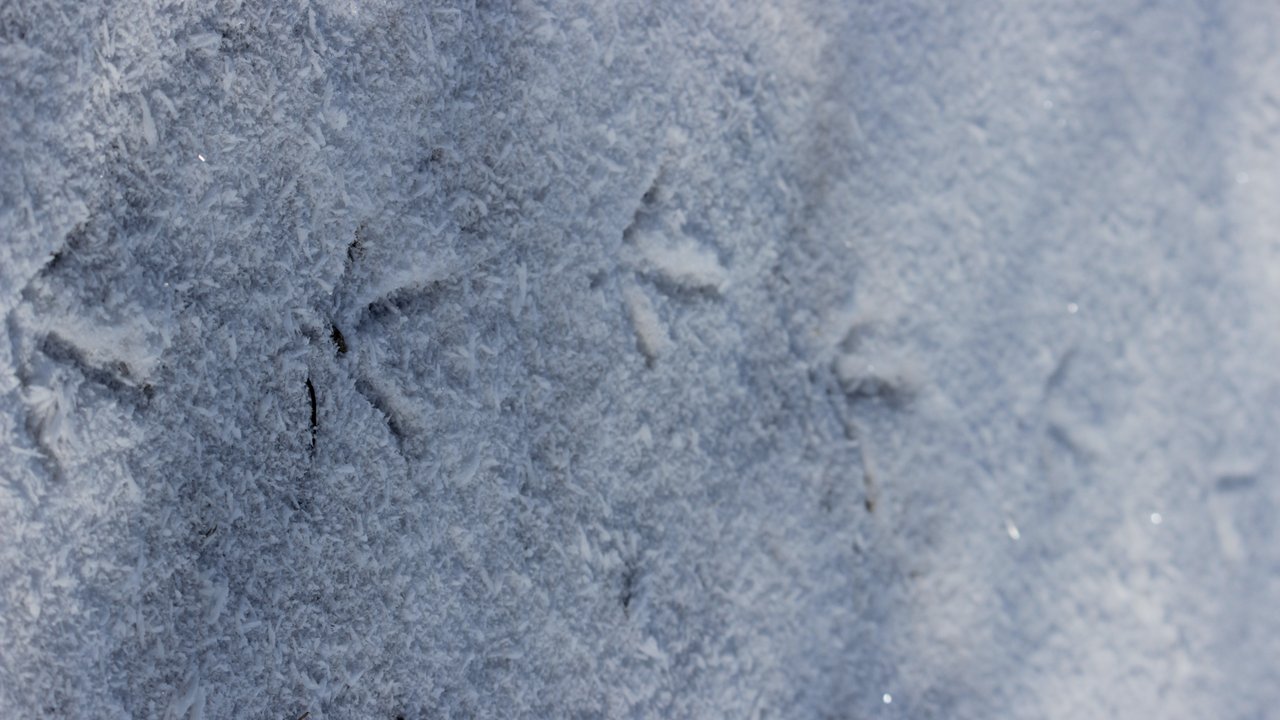
What they look like. Pheasants Forever’s Anthony Hauck describes the snow-day signature: “three-pronged tracks.” Field advice: you’ll see three long front toes splayed forward. The small hind toe often barely registers. A walking bird leaves a nearly straight line of prints, one foot almost in front of the other.
The sweeper. Hauck also describes a print many hunters miss: a “sweeper,” where a rooster’s long tail fans and brushes the snow. MSU Extension notes the hen’s tail runs about 12 inches and the rooster’s is much longer. So a sweeper next to a line of tracks is a decent hint that a rooster made them. Calling it a sure thing is field advice at best.
Where tracks show up. You will rarely see tracks in dry grass. Look where the ground holds an impression: fresh snow, frost, the soft dirt of a field-road shoulder, the mud rim of a slough, a tilled headland, the silt in a culvert mouth.
Field advice: reading a track line.
- Direction. The toes point the way the bird walked. A line of prints running from a grass strip toward picked corn at dawn is a bird going to breakfast. The same line at 3 p.m. is likely a bird going back.
- Freshness. Crisp edges and sharp toe marks in new snow or frost are fresh. Rounded, melted, or blown-in prints are old. A track on top of last night’s frost was made this morning.
- Volume. One line is a bird. A braided highway of tracks between two covers is a travel lane, and that seam is where we would set a blocker or point the dog.
- Don’t follow a running rooster to the horizon. MN DNR warns that pheasants often run in corn, beans, and alfalfa. A long, widely spaced track line heading away from you usually means the bird heard you first.
We are not quoting a track length. Published naturalist figures vary, and the same foot prints bigger in slush than on frozen ground.
Droppings and roost piles
A roost is the single best piece of sign you can find, because it tells you where a bird will be at the edges of the day.
What a pheasant roost looks like. Pheasants Forever’s “Prairie Poo Patrol” piece makes a useful distinction. A bobwhite covey roosts in a tight ring, but pheasants roost alone. So a pheasant roost shows up as a single pile of droppings in a small matted spot, not a circle. Good roosts get reused night after night, so piles build up. PF reports finding them in cattail sloughs, shrub thickets and snowberry, food plots, and tall grass, especially stiff, clumping grasses like wheatgrass, big bluestem, and switchgrass that hold their shape.
Where agencies say birds roost.
- Iowa DNR: tall herbaceous grass is preferred for night roosting. Stands of cattail, bulrush, or switchgrass in the 20–40 acre range make good winter roosts.
- MSU Extension: adult roosting cover is relatively open: grasses, hedges, and weedy crop areas, including tall stubble. Winter roosts are in sweet clover, tall dense cattail, and marsh. Roost sites are usually lower than the land around them but not wet, and birds use the downwind sides of hills and shelterbelts.
- USDA NRCS: pheasants roost on the ground in weedy ditches, marshes, cattail swales, fence corners, and brush heaps, and sometimes in trees, tall shrubs, and hedges, near their feeding areas.
- North Dakota Game and Fish: roosting and escape cover matters September through April, and cattails are the preferred winter habitat.
Field advice: reading droppings.
- Fresh vs. old. Moist, dark, and soft is recent. Dry, pale, and crumbly is old. A fresh pile in a matted bowl is where a bird slept last night, and probably where he will sleep tonight.
- Count the piles, not the birds. Several single piles scattered across a patch of switchgrass or cattail edge mean several birds are using that roost.
- Don’t trash it. If you find a good roost mid-day, walk through it once and leave. Push it hard at noon and you may teach the birds to sleep somewhere else.
- Time it. PF’s advice is to hunt near roosts early, before birds leave, or in the last light as they come back. Check your state’s legal shooting hours on the state page linked above, since we don’t restate them here.
Dust bowls and loafing spots
Between breakfast and supper, birds loaf. MSU Extension describes loafing cover sitting between roosting and feeding areas, with sunning spots, shade, and “spots where they wallow in the dust.” Iowa DNR describes loafing cover as tall weeds or shrubby areas with little ground cover underneath, and notes that open brush lets birds sun on clear winter days.
What a dust bowl looks like. A shallow, rounded scrape in loose, dry soil, often with body-feather fluff, tracks, and a dropping or two around it. Field advice: look along the dry, bare floor of a weedy fence line, under the edge of a shrub row, on the sunny side of a shelterbelt, and on the dirt shoulder of a field road. A cluster of fresh bowls on a south-facing edge means birds are loafing nearby. On a cold, bright morning, that sunny edge is worth a pass before you hit the cattails.
Grit roads
Pheasants have to swallow grit to grind their food. MN DNR says birds walk to roadsides for gravel at first light. MSU Extension names gravel roads as grit sources and notes that hens pick calcium-rich grit. That is why the classic roadside sighting happens at dawn.
Field advice: a rooster on the shoulder at sunrise tells you which cover he roosted in, because he walked there, and which direction he is likely to feed. Note the spot, the time, and the nearest grass and grain. Don’t treat a road sighting as permission or a hunting opportunity. Road and right-of-way rules vary sharply by state; see Road Right-of-Way Hunting Rules.
Feeding edges
This is where the sign ties together. Agencies agree on the menu and on how far birds will commute for it.
- Food. Iowa DNR calls corn and soybeans key fall and winter foods. MN DNR says birds feed in corn, soybean, and small-grain fields. North Dakota Game and Fish says corn and soybeans carry birds through late fall until snow gets too deep.
- Distance. Iowa DNR says pheasants seldom travel more than a quarter mile from winter habitat to feed. MSU Extension says food more than a quarter mile from winter cover is seldom used. NDGF recommends food plots within a quarter mile of winter cover.
- Tillage matters. Iowa DNR reports that fall plowing can drop waste grain from more than 200 pounds per acre to about 15. A disked or plowed field next to great cover may hold far less food than the picked field across the road.
- Water isn’t the draw. Iowa DNR says free water is not required. NDGF and NRCS note birds get water from dew, frost, and their food. Don’t hunt a stock tank expecting birds.
- Livestock. MSU Extension notes pheasants use feedlots and will follow manure spreaders for the grain they scatter.
Field advice: finding the edge. Draw a quarter-mile circle around the best roosting and thermal cover on your map. Inside it, look for the line where picked grain (not fall-tilled ground) meets grass, cattail, or brush. That seam is your feeding edge. Tracks, droppings, and scratch marks in the stubble right along it mean birds are using it now. MN DNR’s own tactics advice is to work transition areas and walk into the wind, so the dog gets the scent and the birds hear less of you.
Feathers and scratching
Field advice. A few loose body feathers in a roost or dust bowl are normal. A tight pile of feathers with no bird usually means a predator or a hunter got there first. Either way, it tells you birds are in the area. Scratch marks are a different story. MSU Extension notes pheasants can scratch through several inches of snow to reach food. Fresh scratches in snowy stubble beside cover are among the clearest feeding sign you will find.
Weather changes the reading
MN DNR’s rule of thumb, “the nastier the weather, the deeper into cover,” governs everything above. MSU Extension notes birds face into storms and can go about two weeks without food in extreme conditions. NDGF lists thermal cover as critical October through March. In practice:
- Calm, bright days: expect fresh sign along feeding edges and on sunny loafing spots.
- Wind, cold, and snow: expect sign to concentrate in cattails and dense grass, and on the downwind side of shelterbelts and hills (MSU). NDGF warns that narrow 1–4 row tree belts can become snow traps, and that South Dakota studies found birds using trees only in severe winters.
- Fresh snow: the best tracking day of the year, as covered in Hunting Pheasants After the First Snow.
More on fronts and wind in Weather and Pheasant Movement.
From sign to plan
| What you find | What it likely means | Field-advice play |
|---|---|---|
| Single dropping piles in matted grass or cattail | Night roost, often reused (PF; Iowa DNR) | Hunt the edges of the day, or approach from downwind and push toward a blocker |
| Fresh track line, grass → picked grain | Morning feeding commute (MN DNR) | Work the seam mid-morning, then shift to dense cover |
| Braided tracks between two covers | Travel lane | Post a blocker on the lane and drive toward it |
| Dust bowls on a sunny, bare edge | Loafing spot (MSU Extension) | Bright cold mornings: hit it before the cattails |
| Scratches in snowy stubble | Active feeding (MSU Extension) | Check cover within a quarter mile (Iowa DNR; MSU) |
| Rooster on a gravel shoulder at dawn | Grit stop between roost and feed (MN DNR; MSU) | Note the roost cover he walked from, and learn the right-of-way rules first |
| Sign gone after a cold front | Birds tucked into thermal cover (MN DNR; NDGF) | Go deeper: cattails, dense CRP, downwind shelterbelt sides |
For how those covers change week to week after harvest, see Late-October Cover Shifts. For working cattails specifically, see Cattail and Slough Tactics for Roosters.
A note on preserve birds
Pen-raised birds released on a shooting preserve or controlled shooting area haven’t spent a season building roost piles and travel lanes. Expect less sign, and less meaningful sign, than you would see on wild-bird ground. How the two hunts differ, and what each state allows, is covered in Wild Birds vs. Preserve Hunts.
Name TBD · Why it matters: glassing roadside grit stops and field edges at first light without walking in · Who it's for: hunters scouting new walk-in ground from the truck · Partner link coming
Name TBD · Why it matters: drop a pin on every roost and feeding edge so next week's hunt starts where this week's sign was · Who it's for: anyone hunting the same walk-in tracts more than once · Partner link coming
Related
- Wild Birds vs. Preserve Hunts
- Late-October Cover Shifts
- Hunting Pheasants After the First Snow
- Mid-Season Scout Notes After Opener Week
- Weather and Pheasant Movement
- Cattail and Slough Tactics for Roosters
- Shelterbelt and Tree-Row Pheasant Tactics
- CRP and Pheasant Habitat Basics
- GPS and Offline Maps for Walk-In Days
Sources
- Minnesota DNR — Pheasant hunting tips (daily schedule: roost in short-to-medium grass/weeds; roadsides for grit at first light; feeding ~8 a.m. in grain; mid-morning to densest cover; "the nastier the weather, the deeper into cover"; birds run in corn, beans, alfalfa)
- Minnesota DNR — Hunting pheasants (scout for tracks, roosts, droppings, birds; roost in grasslands, feed in corn/soy/grain; transition areas; walk into the wind)
- Iowa DNR — Ring-Necked Pheasant (tall grass night roosts; loafing cover; 20–40 acre cattail/bulrush/switchgrass winter roosts; corn and soybeans; fall plowing >200 → ~15 lb/acre waste grain; seldom >¼ mile to feed; water not required)
- Montana State University Extension — Ring-Necked Pheasant Management (loafing and dusting; roost-site traits; downwind sides of hills and shelterbelts; food >¼ mile seldom used; scratching through snow; facing into storms; gravel-road grit, calcium grit; two feeding periods; tail lengths; feedlots)
- North Dakota Game and Fish — Habitat Needs of Pheasants (roosting/escape cover Sept.–April; thermal cover Oct.–March; cattails preferred winter habitat; water from dew, frost, food; food plots within ¼ mile; narrow tree belts; SD tree-use studies)
- USDA NRCS — Biology Technical Note 190-07, Ring-necked Pheasant (ground and elevated roost sites near foraging areas; water from foods)
- Pheasants Forever — Prairie Poo Patrol (single-bird roost piles vs. quail rings; reused roosts; roost cover types)
- Pheasants Forever — Ringnecks in First Snow (Anthony Hauck) (three-pronged tracks; tail "sweeper")
- On this site: Wild Birds vs. Preserve Hunts · Late-October Cover Shifts · Hunting Pheasants After the First Snow
- Agency and extension pages above checked 2026-10-22. Pheasants Forever pieces are conservation-organization field writing, cited for sign descriptions, not regulation.
- No seasons, shooting hours, bag limits, or prices are restated. "First light" and "last light" describe bird behavior, not legal hours; confirm legal hours with each state.
- No track measurements are quoted; we found no state-agency figure. Track-reading, dropping freshness, dust-bowl spotting, and the sign-to-plan plays are labeled field advice.