Hunting Pheasants After the First Snow
The first real snow is the best scouting report you will get all year, and it shows up for free. Overnight the prairie becomes a ledger. Every rooster that walked from roost grass to waste corn signed his name, and every slough with standing cattails starts to look like the only good address in the county. Birds that ran circles around you in October now sit tight in thick cover, and the hunter who reads the snow honestly can make a December day out of three hours.
This page is about the morning after, across South Dakota, Nebraska, Kansas, Iowa, North Dakota, Minnesota, and Montana: where birds go, how to read the tracks, how to keep a dog sound on crust and ice, and which rules stay exactly the same no matter how pretty the sunrise is. Pair it with Weather and Pheasant Movement, Late-Season Pheasant Tactics, Shelterbelt and Tree-Row Tactics, and Pheasant Dog Gear Checklist.
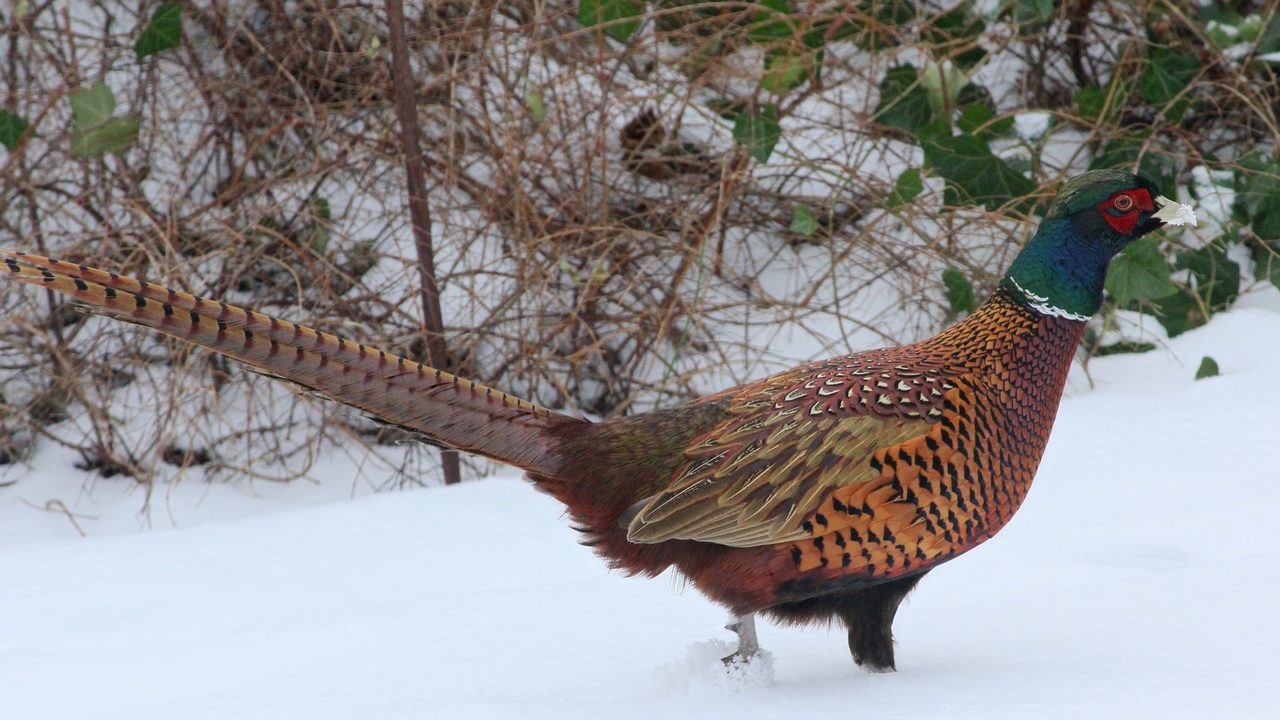
What snow does to a pheasant’s day
Pheasants do not leave for warmer country. They move to cover that still works. North Dakota Game and Fish puts the year in plain terms: birds live on a home range of about one square mile but may travel up to 10 miles to find winter cover, and the leading killers of adult pheasants are winter exposure and predation, not hunters (NDGF Habitat Needs of Pheasants).
The same agency page says cattails are preferred winter habitat, offering protection from bitter wind and heavy snow, and that cattail sloughs inside cropland are ideal because the food (waste grain) is next door. It also says South Dakota studies found hens used tree cover only at the end of a severe winter; in ordinary winters they leaned on cattails, tall grass, and food plots. Minnesota DNR adds a detail worth respecting: in extreme winter weather a pheasant can go up to two weeks without feeding by slowing its metabolism (MN DNR, Hunting pheasants).
Hunter translation: After the first accumulating snow, birds stop spreading out. They bunch in the best thermal cover close to food, they move less, and they would much rather hold than fly. That is good news for you and a fair reason to take only your share.
The snow ladder: which cover to hunt first
Not every snow is the same snow. Match the cover to the depth.
| Snow on the ground | Where birds tend to be | How to hunt it |
|---|---|---|
| Dusting, grass tips showing | Still scattered in grass and CRP, edging toward food | Read tracks from roost to feed; work fence lines, ditches, and crop edges |
| A few inches of powder | Holding tighter in rank grass cores and cattail fringes | Slow down. Pause often. Let the dog work every clump. |
| Grass buried, drifts building | Cattail sloughs, standing food plots, wide shrub blocks | Lee side of the cattails first, then the food edge |
| Crust or ice on top | Birds run on the surface and flush long | Brushy draws and short pushes; skip the marathon slough |
| Severe storm, bitter wind | Locked down in the deepest thermal cover | Often the right call is to stay home, then hunt the calm day after |
A note on tree rows. NDGF warns that narrow 1–4 row tree belts collect snow and can bury and suffocate birds looking for shelter, and that linear belts hand predators a travel lane and a perch. Wide shrub blocks, at least 15 rows in the agency’s planting guidance, are a different story. When you have a choice, the fat shrub block and the cattail slough beat the skinny windbreak. More on woody cover in Shelterbelt and Tree-Row Tactics.
Food plots and standing crops
NDGF recommends that winter food plots sit within a quarter mile of winter cover so birds are not exposed while traveling, and notes that a mix of millet, corn, and grain sorghum is the most reliable winter food. It also says corn and soybeans feed birds in late fall until snow gets too deep, and that tall stubble can provide food and thermal cover depending on snowfall.
That gives you a simple map. Find the cattails or the shrub block. Find the nearest standing food or tall stubble. The quarter mile between them is where the tracks will be. Hunt the cover in the loafing hours, and the edge between cover and food when birds are moving, always inside your state’s legal hours.
On public and walk-in ground, food plots are part of the land manager’s habitat plan. Walk them, hunt them, and leave the standing rows standing.
Reading tracks without fooling yourself
Fresh snow is honest, but it is not a GPS collar.
- Fresh vs. stale: Sharp edges and crisp toe prints mean recent. Rounded, wind-filled, or sun-softened tracks mean older. Tracks under a skim of new snow came before the last flurry.
- Pheasant prints show three forward toes in a narrow, nearly straight line, with the stride close to a walking chicken’s. Several sets braiding into a slough is a loafing area. A single set wandering a field edge is a bird feeding.
- Wing marks in the snow often mean a flush or a landing. Fresh ones beside a set of tracks tell you the bird is airborne, not hiding.
- Roost sign: Small bowls in the snow with droppings, often in grass or cattail edges, mark where birds spent the night. Minnesota DNR lists tracks, roosts, and droppings as sign worth scouting for, and notes birds are most visible early and near sunset as they move between roost, gravel, and feeding areas.
- Do not follow one track for a mile. A running rooster will always win. Use tracks to choose the cover, then hunt the cover.
When the tracks all point into a slough and nothing comes out the other side, you have done your scouting. Set up and hunt it right.
Wind, temperature, and how to approach
The rule that matters most in snow is the same one Minnesota DNR states for every day: walk into the wind when you can. It keeps your noise downwind and puts scent in your dog’s nose. DNR also says pheasants hear well, so do not slam truck doors, and start away from the parking lot when the layout allows (MN DNR, Hunting pheasants).
In snow, sound carries. A calm, cold morning can make a tailgate sound like a starter’s pistol.
Practical moves:
- Hunt the lee side. After a northwest wind, birds sit on the sheltered, downwind edge of cattails and shrub blocks. Start there.
- Calm, sunny day after a storm: Birds often loaf in thermal cover through the middle of the day. Push the cattails then, and save the food edge for later in legal light.
- Windy and cold: Shorter pushes, tight cover, and blockers on the exit tip if you have the people. See Pushers and Blockers: Safe Small-Party Drives.
- Bitter cold: Shorten the day for the dog’s sake and your own. A rooster is not worth frostbite.
Your dog on snow and ice
Snow days can be the best dog days of the year and the hardest on paws. Treat this section as field advice from people who have pulled ice balls out of a lot of toes.
- Ice balls between the toes are the classic snow-day problem. Check feet at every stop. Booties or a paw wax help; trim long hair between the pads before the season if your dog grows it.
- Crusted snow cuts. Sharp crust and frozen cattail stubs can slice pads and legs. Bring a basic first-aid kit and know how to wrap a foot: First Aid and Truck Kit for Upland.
- Water still matters. Cold days dry dogs out too. Eating snow is not hydration. Carry water and offer it.
- Energy and warmth. A wet dog in wind loses heat fast. Towel off, use a crate pad or blanket, and give your dog a real rest between pushes.
- Visibility. A brown dog against cattails is hard to see, and so is a white-ticked dog against snow. An orange vest or collar keeps the dog in sight of every gun. Gear list: Pheasant Dog Gear Checklist.
- Long flushes on crust. Birds that run on top flush wild. Mark falls carefully and do not send a soft-footed dog on a long retrieve across open ice.
Ice on sloughs: the part that can end the day
Early winter is when cattail sloughs look most inviting and their ice is least trustworthy. Minnesota DNR’s ice-safety guidance is the cleanest official reference in our footprint, and it applies to a slough in Nebraska as much as a lake in Minnesota:
- There is no such thing as 100 percent safe ice.
- For new, clear ice only, DNR’s general guideline is stay off under 4 inches; about 4 inches for activities on foot.
- Snow insulates ice and slows freezing. It also adds weight. Snow that melts and refreezes forms white ice, about half as strong as new clear ice, so DNR says to double the thickness guidelines on white ice.
- Ice seldom freezes evenly. It can be thick in one spot and an inch or two a few feet away. Ice over moving water, springs, and culverts is especially dangerous.
Sources: MN DNR Ice safety · MN DNR ice thickness guidelines.
For pheasant hunters, that means:
- Hunt the edges, not the middle, of a cattail slough early in the winter. Minnesota DNR lists snow, plant decay, and springs among the things that weaken ice, and a cattail slough can have all three.
- Do not go out after a dog that breaks through. Call the dog toward you and toward shore. The second person on bad ice is how one emergency becomes two.
- Plan retrieves. If a bird falls on open ice you do not trust, let it go. That is a hard rule worth keeping.
- Hunt with a partner and tell someone where you parked.
Blaze orange against snow
Blaze reads well against snow. A brown coat does not, and a white or gray one is worse. Two states in our footprint require blaze for pheasant hunters, and deer seasons overlap late pheasant days in several more.
- Iowa: Upland hunters must wear at least one visible outer garment that is at least 50% solid blaze orange (Iowa DNR pheasant hunting).
- Minnesota: Pheasant hunters must wear at least one visible blaze orange or pink article above the waist. Rules tighten while firearms or muzzleloader deer seasons are open (MN DNR pheasant; MN DNR blaze clothing).
- Montana: Not required for upland birds, but FWP says swinging on an upland bird and shooting another hunter is the leading cause of hunting-related accidents in Montana, and strongly recommends at least a hunter-orange hat (FWP 2026 Upland Game Bird regulations, PDF).
- Elsewhere, wear it anyway, especially when December deer seasons overlap your pheasant days. Kansas, Nebraska, Iowa, and others run deer seasons in late fall and winter; confirm the deer-season dates and any orange rules on the agency page before you go.
The full state-by-state table lives on Blaze Orange Requirements by State.
The rules that do not change when it snows
Snow makes birds easier to find. It does not move a season, raise a bag, or stretch shooting hours. Here is the planning table from the agencies, checked for this guide. Confirm on the live page before every trip.
| State | 2026–27 regular season (planning) | Shooting hours | Snow-season note |
|---|---|---|---|
| South Dakota | Traditional season ends Jan. 31, 2027 (GFP Key Dates) | 10 a.m. Central to sunset, all season (GFP pheasant) | Several refuges open late: Sand Lake NWR Dec. 14–Jan. 31; Renziehausen, Gerken, and White Lake refuges Dec. 1–Jan. 31 (GFP) |
| Nebraska | Oct. 31, 2026 – Jan. 31, 2027 (NGPC hunting seasons) | Confirm in the NGPC Small Game guide | NGPC lists a Dec. 1–31 muzzleloader deer season; wear orange |
| Kansas | Nov. 14, 2026 – Jan. 31, 2027 listed on KDWP When to Hunt (KDWP); confirm in the regulations summary | ½ hour before sunrise to sunset (KDWP, all game birds) | Firearm deer season falls in early December; confirm dates on KDWP |
| Iowa | Oct. 31, 2026 – Jan. 10, 2027 (Iowa DNR seasons) | 8 a.m. – 4:30 p.m. | Short winter days plus a hard 4:30 stop. Plan the walk out. |
| North Dakota | Oct. 10, 2026 – Jan. 3, 2027 (NDGF pheasant) | 30 minutes before sunrise to sunset (confirm in the NDGF small-game proclamation) | Snow can block trails and section lines to PLOTS and WMA tracts; check roads before you drive |
| Minnesota | Oct. 10, 2026 – Jan. 3, 2027 (MN DNR pheasant) | 9 a.m. to sunset | Daily bag goes from 2 to 3 roosters on Dec. 1 (possession 6 to 9), per DNR |
| Montana | Regular season through Jan. 1, 2027; nonresident public/BMA dates differ (see the Montana guide) | ½ hour before sunrise to ½ hour after sunset (FWP Upland PDF) | Use the official sunrise-sunset tables in the FWP booklet |
Bag and possession limits are on each state page: SD · NE · KS · IA · ND · MN · MT. Roosters only, everywhere. Snow makes hens easy to see, so make them easy to pass.
Access after a storm. Snow closes roads and buries pull-offs. Walk-in and public parcels can change for grazing or landowner decisions. Refresh the atlas the night before, download maps for offline use, and never block a gate or plowed farm lane: Finding Parking on Walk-In Tracts · GPS and Offline Maps for Walk-In Days.
A word on fair chase in hard winters
Agency habitat staff are clear that winter is the bottleneck for pheasants. Bunched birds in a single slough during a hard January are easy to over-hunt. Good hunters take a reasonable share, leave a slough alone after one honest push, and avoid pushing birds out of their last good cover during the worst storms. That is not a regulation. It is how there are birds next year.
Morning-after-snow checklist
- [ ] Confirm season, bag, and legal hours for the state you are standing in
- [ ] Refresh walk-in and public-land maps; check road conditions
- [ ] Booties or paw wax, towel, crate pad, water, and first-aid kit for the dog
- [ ] Blaze on you and orange on the dog
- [ ] Plan: lee-side cattails or shrub block first, food edge second
- [ ] Hunt into the wind; quiet doors; start away from the lot
- [ ] Stay off slough ice you have not checked. Never chase a dog onto bad ice.
- [ ] One good push per cover, then move on
Featured gear — partner slots
Empty until a real partner exists. Warm feet and a visible dog matter more than brand names.
Name TBD · Why it matters: ice balls and crust cuts end snow days early · Who it's for: any dog working late-season cover · Partner link coming
Name TBD · Why it matters: cold feet shorten the best tracking day of the year · Who it's for: hunters walking powder and frozen sloughs · Partner link coming
Related
- Weather and Pheasant Movement
- Late-Season Pheasant Tactics
- Shelterbelt and Tree-Row Pheasant Tactics
- Late-October Cover Shifts
- Pushers and Blockers: Safe Small-Party Drives
- Pheasant Dog Gear Checklist
- First Aid and Truck Kit for Upland
- Blaze Orange Requirements by State
- Upland Boots Buying Guide
Sources
- North Dakota Game and Fish — Habitat Needs of Pheasants (1 sq. mi. home range, up to 10 miles to winter cover; winter exposure and predation lead adult mortality; cattails preferred winter habitat; SD studies on tree use only in severe winters; narrow 1–4 row belts as snow traps; 15-row shrub blocks; food plots within ¼ mile of winter cover; corn/soy until snow too deep; tall stubble)
- Minnesota DNR — Hunting pheasants (cattails as winter thermal cover; scouting for tracks, roosts, droppings; walk into the wind; quiet doors; start away from the lot; up to two weeks without feeding in extreme winter)
- Minnesota DNR — Ice safety (no 100 percent safe ice; snow insulates and slows freezing; uneven ice; danger over current)
- Minnesota DNR — Ice thickness guidelines (new clear ice: stay off under 4 inches; 4 inches on foot; white ice about half as strong, double guidelines)
- Minnesota DNR — Pheasant hunting (Oct. 10, 2026 – Jan. 3, 2027; 9 a.m. to sunset; 2 daily / 6 possession through Nov. 30, 3 / 9 from Dec. 1; blaze above the waist)
- Minnesota DNR — Blaze clothing requirements
- South Dakota GFP — Pheasant (10 a.m. Central to sunset all season; delayed refuge openings)
- South Dakota GFP — Key Dates (traditional pheasant season end Jan. 31, 2027)
- Nebraska Game and Parks — Hunting seasons (pheasant, quail, partridge Oct. 31, 2026 – Jan. 31, 2027; deer season dates)
- Kansas KDWP — When to Hunt (game-bird hours ½ hour before sunrise to sunset; 2026–27 season Nov. 14, 2026 – Jan. 31, 2027 listed)
- Iowa DNR — Hunting seasons (rooster pheasant Oct. 31, 2026 – Jan. 10, 2027; 8 a.m. – 4:30 p.m.)
- Iowa DNR — Pheasant hunting (blaze orange requirement)
- North Dakota Game and Fish — Pheasant (regular season Oct. 10, 2026 – Jan. 3, 2027, finalized)
- Montana FWP — 2026 Upland Game Bird regulations (PDF) (hours ½ hour before sunrise to ½ hour after sunset; hunter orange strongly recommended; leading cause of hunting accidents)
- Season dates and hours checked on live SD GFP, NGPC, KDWP, Iowa DNR, NDGF, and MN DNR pages and the MT FWP 2026 Upland PDF (fetched 2026-10-09). ND hours and MT season end carried from this site's state guides; confirm live.
- Nebraska shooting hours not stated on the NGPC seasons page; confirm in the Small Game guide.
- Track reading, dog care, and slough-edge tactics are field advice, not agency rules. No bag counts, harvest numbers, or license prices invented here.